+13pp
In a randomized trial with medical residents, repeated testing with feedback beat repeated study on a final test >6 months later
A 10-minute self-check to spot “illusion of learning,” then upgrade your study loop with retrieval, feedback, and spacing—without studying longer.
Long-delay example
+13pp
In a randomized trial with medical residents, repeated testing with feedback beat repeated study on a final test >6 months later
Evidence base
Meta-analysis
Testing (retrieval) often improves retention more than restudy, with effects depending on conditions like delay and test format.
Spacing evidence
Meta-analysis
Distributed practice (spacing) shows robust benefits across many experiments, and timing (lag vs retention interval) matters.
Most study time fails quietly: it feels productive but doesn’t stick. Use this quick self-check, then apply 3 proven fixes.
Most people “study” in a way that feels productive but doesn’t survive time. If your routine mostly creates familiarity (rereading, highlighting, skimming), it can inflate confidence without building recall. A better test is simple: can you produce answers without looking, correct yourself quickly, and still do it after a delay? Today, run the 10-minute self-check below and apply the three fixes: retrieval, feedback, and spacing.
For students, self-learners, and busy professionals who feel “I studied… but I don’t retain.” If your goal is durable recall (exams, interviews, work knowledge), this is for you. If you only need short-term familiarity for a quick meeting tomorrow, this may be overkill—though the self-check still reveals what will (and won’t) stick.
You’re learning properly if you can produce the answer without looking, correct it with feedback, and still produce it after time has passed. That loop is the core of the “testing effect”/retrieval practice literature. PubMed
Pick a small chunk you studied recently: one subheading, one lecture segment, or one concept cluster. Set a timer for 10 minutes, close everything, and do the check below. When you’re done, open your material and mark what was missing, vague, or wrong.
10-minute self-check steps:
(1) Write 5 key ideas in your own words.
(2) Explain the hardest idea in 5 sentences as if teaching a beginner.
(3) Write 3 exam-style questions and answer them closed-book.
(4) Compare with notes and highlight gaps.
If this felt harder than expected, you didn’t “fail”—you discovered a method problem, not an ability problem. Many “comfortable” techniques raise familiarity fast while leaving retrieval weak. If you like learning by doing, you can turn this exact check into a quiz in minutes using Quizzence → Create Quiz.
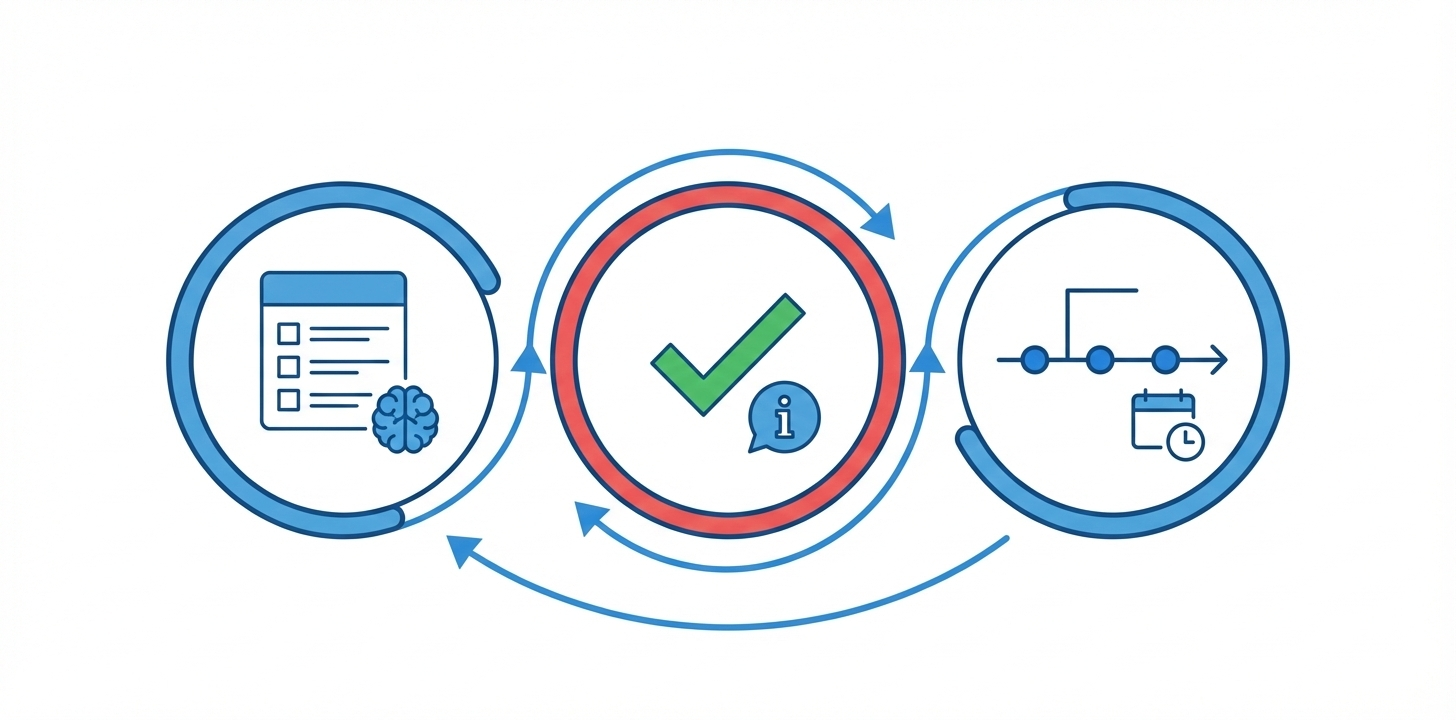
Rereading and highlighting are seductive because they’re smooth. You can do them tired, they look like progress, and your brain rewards you with fluency: “I’ve seen this, so I must know it.” But exams, interviews, and real tasks don’t ask whether a page feels familiar—they ask whether you can produce and use information when it isn’t in front of you. That’s why you can highlight 12 pages and then go blank on a blank sheet: the study trained recognition, not retrieval. Classic work on test-enhanced learning shows retrieval can strengthen later retention beyond additional study, especially when there’s a meaningful delay. PubMed
(If you enjoy this kind of “illusion vs reality” breakdown, you’ll find more like it on the Quizzence blog.)
Retrieval practice means actively pulling knowledge out of memory. The key detail is closed-book effort: you attempt an answer before looking anything up, even if you feel unsure. That effort matters because it forces your brain to reconstruct what you know, rather than letting you “recognize” the material while it sits in front of you. In research terms, this is the backbone of the testing effect: retrieval isn’t only measurement—it’s a learning event. PubMed
The easiest way to start is tiny: after reading a section, write 8–12 prompts and answer them without notes. Prefer some short-answer prompts (produce the answer) rather than only recognition prompts (choose the answer), because recognition can let you “feel right” without actually owning the knowledge. Synthesis-level evidence supports retrieval practice over non-testing conditions for longer-term retention, with effects depending on how it’s implemented. PubMed PubMed
Practical shortcut: paste your notes (or upload a PDF) and generate prompts in Quizzence → Create Quiz, then treat the first attempt as training, not judgement.
Retrieval without correction can stall. The attempt tells you where your map is wrong; feedback redraws the map. In practice, feedback can be brutally simple: check the correct answer, rewrite it once in your own words, then re-answer the same prompt while the correction is fresh. That turns “I got it wrong” into “I fixed the weak spot,” which keeps motivation stable.
Nuance worth saying out loud: testing can help even without feedback in some conditions, but feedback often boosts gains and reduces the risk of learning wrong answers—especially for multiple-choice, where tempting lures can plant misinformation. PubMed
Real-world example: in a randomized trial with medical residents, repeated testing with feedback beat repeated study on a final test taken more than six months later (39% vs 26% — +13 percentage points, absolute difference). It’s not a guaranteed “+13pp for everyone.” It’s a concrete illustration of what the loop (retrieve + feedback + time) can do under realistic delays. PubMed
In Quizzence terms, this is the workflow: generate prompts → attempt → review what you missed → re-try. (You can start it here: Create Quiz.)
Same-day study can feel amazing and still vanish next week. That’s not because you’re bad at learning; it’s because your schedule never asked memory to work after forgetting began. Spacing forces retrieval when the answer is no longer warm in working memory—and that is exactly what builds durability.
Spacing is one of the safest bets in learning science: a major meta-analysis of distributed practice reviewed hundreds of experiments and found robust spacing benefits, with timing (lag) interacting with how long you need to retain the information. A practical review also emphasizes that spaced repetition is efficient and broadly applicable. PubMed SAGE
If you want a simple rule that’s “good enough” for most topics: retrieve today, retrieve tomorrow, retrieve again in 3–7 days. Then keep a light maintenance rhythm if the knowledge matters long-term. PubMed
Flashcards aren’t a method; they’re a container. Used well, they are retrieval practice. Used poorly, they become passive review in disguise. The difference is a two-second pause: if you look at the front and immediately flip, you’re training recognition. If you answer out loud or in writing, then flip to check, you’re training retrieval. Implementation details—effort, feedback, spacing—are why “flashcards worked for my friend but not for me” is such a common story. PubMed PubMed
Mistake #1: “I’ll know it when I see it.” That’s recognition, not recall.
Mistake #2: Dropping cards after one correct answer. Keep “easy” items in rotation longer than feels necessary.
Mistake #3: Only same-day review. If you never retrieve after a delay, you never train durability.
Mistake #4: No correction step. Without feedback, you can rehearse wrong answers (especially with multiple choice). PubMed
Minute 0–5: create 8–12 prompts from what you just learned (mix definition, example, and why/how prompts). Minute 5–12: answer closed-book (write or speak). Minute 12–17: check answers and add a one-line correction or explanation to anything missed. Minute 17–20: re-test only what you missed, plus one easy “confidence” prompt. Tomorrow, repeat only the missed prompts plus three you got right. In 3–7 days, repeat again. This routine isn’t magical; it simply forces the ingredients that evidence keeps rewarding: retrieval, feedback, and time. PubMed PubMed
If you want to run this routine with zero setup work, start with: Quizzence → Generate a quiz.

The real reason people don’t study “properly” is usually friction. Writing decent prompts takes time, so rereading becomes the default because it’s always available. Quizzence is built to remove that bottleneck—without pretending to replace the learning science. Quizzence
Here’s the clean mapping: generating prompts (from text or uploaded documents) supports retrieval; attempts + review supports feedback; and a consistent “come back later” workflow supports spacing. In other words, the product is useful when it makes the evidence-backed loop easier to start and easier to repeat.
Retrieval practice is not a replacement for understanding. If you have zero foundation, you may need an initial pass to build meaning before quizzing becomes productive. Also, effect sizes vary by materials, learners, delays, feedback timing, and test formats; meta-analyses treat these as moderators, not guarantees. The practical goal is not a promised number—it’s a reliable habit: retrieve, correct, return later. PubMed
These are interpretation/translation layers: they don’t replace primary studies, but they do a great job turning the evidence into usable mental models and classroom/self-study examples. If you read one, treat it like a lab manual: pick one principle, apply it for a week, observe results, adjust.
Recommended: Make It Stick (retrieval, spacing, interleaving), Powerful Teaching (retrieval practice in classrooms), Understanding How We Learn (visual, evidence-first), Why Don’t Students Like School? (memory + thinking), How Learning Works (research-based learning design). (Publisher pages in References.)
Sources were prioritized in this order: peer-reviewed meta-analyses and evidence reviews first, then classic experimental work on test-enhanced learning, then applied studies with real learners and meaningful delays. For numeric claims (like 39% vs 26% after >6 months), we cite the primary source. For “what generally works,” we cite synthesis-level evidence. When a claim depends on implementation details (feedback timing, test format, spacing schedule), we say so rather than pretending it’s universal. PubMed PubMed PubMed
Do the 10-minute self-check on one topic. Then replace your next reread with an 8–12 prompt closed-book quiz, correct mistakes immediately, and schedule two repeats (tomorrow and 3–7 days). If you want the fastest start, generate a quiz from your notes or doc and treat the first attempt as training, not judgement: Create a quiz in Quizzence.